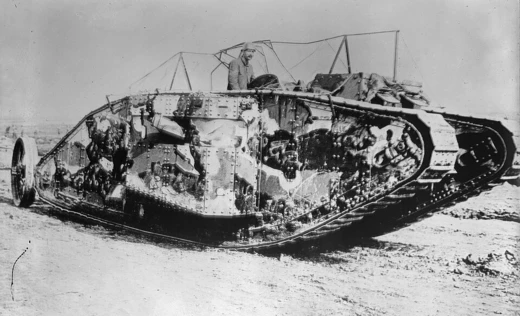
Tiger I
German heavy tank of World War II, first with 8.8 cm KwK 36 gun.

via Wikipedia: Tiger I · see source
The Tiger I was a German heavy tank of World War II that began operational duty in 1942 in Africa and in the Soviet Union, usually in independent heavy tank battalions. It gave the German Army its first armoured fighting vehicle that mounted the 8.8 cm KwK 36 gun (derived from the 8.8 cm Flak 36, the famous "eighty-eight"). 1,347 were built between August 1942 and August 1944. After August 1944, production of the Tiger I was phased out in favour of the Tiger II.
- nationality
- German
- known_for
- First German tank to mount the 8.8 cm KwK 36 gun; heavy armor; nickname 'Tiger'
- production_period
- August 1942 – August 1944
- main_armament
- 8.8 cm KwK 36 L/56
- engine
- Maybach HL210 P45 (later HL 230 P45) V12 petrol
Verified Timeline
Lore & Background
The Tiger I was born from combat experience against French SOMUA S35 and Char B1 heavy tanks, and the British Matilda II infantry tanks during the Battle of France in June 1940, which showed the German Army needed better armed and armoured tanks. On 26 May 1941, Henschel and Ferdinand Porsche were asked to submit designs for a 45-tonne heavy tank, to be ready by June 1942. On 22 June 1941, Germany launched Operation Barbarossa, encountering large numbers of Soviet T-34 and KV-1 tanks. According to Henschel designer Erwin Aders, "There was great consternation when it was discovered that the Soviet tanks were superior to anything available to the Heer." The due date for new prototypes was set for 20 April 1942, Adolf Hitler's 53rd birthday. Porsche and Henschel submitted prototype designs, each using a Krupp-designed turret, demonstrated at Rastenburg in front of Hitler. The Henschel design was accepted, mainly because the Porsche VK 4501 (P) prototype used a troubled petrol-electric transmission system needing large quantities of copper, a strategic war material of which Germany had limited supplies. Expecting an order, Porsche built 100 chassis; after the contract went to Henschel, 91 hulls were converted into the Panzerjäger Tiger (P) in early 1943. The Tiger was still at prototype stage when first hurried into service, and changes were made throughout production, including a redesigned turret with a lower cupola and the dropping of river-fording submersion capability and external air-filtration system to cut costs.
Reader's Guide
The Tiger I differed from earlier German tanks principally in its design philosophy, prioritizing thick armour and a powerful gun over the balance of mobility, armour, and firepower seen in predecessors. Its frontal hull armour was 100 mm thick, frontal turret 100 mm, and gun mantlet varying from 110 mm around the edges to 200 mm around the gun. At the height of its service, the Tiger's front was practically invulnerable to all Allied guns except the British 17-pounder, US 90-mm, and Soviet 122-mm guns. British firing tests found the 60 mm lower hull side plate offered resistance equivalent to 80 mm of British RHA, and the 80 mm upper hull plate equivalent to 90 mm. The 8.8 cm KwK 36 gun was highly accurate; in British wartime firing trials, five successive hits were scored on a 16 by 18 inch target at 1,200 yards. However, the Tiger was criticized as overengineered, using expensive materials and labour-intensive production methods. It was prone to track failures and breakdowns early on, and its overlapping and interleaved Schachtellaufwerk-pattern road wheels could jam when mud, ice, and snow froze between them. Despite these issues, it was generally mechanically reliable. Only nine Tiger I tanks survive today in museums and private collections worldwide; as of 2021, Tiger 131 at the UK's Tank Museum is the only example restored to running order.
Did You Know?
- The Tiger I was nicknamed 'Tiger' by the ministry for armament and ammunition by 7 August 1941, before the tank even entered production.
- Only nine Tiger I tanks survive today, and as of 2021, Tiger 131 at the UK's Tank Museum is the only one restored to running order.
- The Porsche prototype for the Tiger I used a petrol-electric transmission that required large quantities of copper, a strategic material Germany lacked.
- British firing tests found that the Tiger's 60 mm lower hull side plate offered resistance equivalent to 80 mm of British RHA.
- The 8.8 cm KwK 36 gun could score five successive hits on a 16 by 18 inch target at a range of 1,200 yards in British wartime trials.
The Rivalry That Forged a Legend
The Tiger I was born from a painful reckoning rather than a single flash of inspiration. During the 1940 Battle of France, German crews found themselves outmatched by French SOMUA S35 and Char B1 vehicles as well as British Matilda II infantry tanks, a stark reminder that the existing Panzer lineup lacked the punch and protection a modern battlefield demanded. By 26 May 1941, the Wehrmacht formally tasked both Henschel and Ferdinand Porsche with producing a 45-tonne heavy tank. Henschel responded with two prototype variants—one armed with an 8.8 cm L/56 cannon, the other with a 7.5 cm L/70—while Porsche refined his earlier VK 30.01 (P) concept. The invasion of the Soviet Union on 22 June 1941 added urgency: encountering T-34 and KV-1 tanks in quantity sent shockwaves through German command. According to Henschel designer Erwin Aders, "There was great consternation when it was discovered that the Soviet tanks were superior to anything available to the Heer." Both firms ultimately presented their machines at Rastenburg before Hitler. Henschel's design prevailed, largely because Porsche's petrol-electric drivetrain demanded vast quantities of copper, a strategic metal Germany could not spare. Porsche, who had already fabricated 100 chassis in anticipation of the contract, saw 91 repurposed into the turretless Panzerjäger Tiger (P) destroyer. Henschel production began in August 1942.
Steel That Defied the Guns
The Tiger I rejected the sloped-armour philosophy that would later define the Panther, instead relying on thick, flat plates welded in an interlocking construction. The frontal hull and turret each carried 100 mm of steel, while the gun mantlet ranged from 110 mm at its thinner edges to a full 200 mm directly around the barrel. Side hull plates measured 60 mm, the superstructure and sponsons 80 mm, and the turret sides and rear 80 mm as well. British firing tests after capture revealed that the steel itself was of exceptional quality: a 60 mm side plate resisted impact as though it were 80 mm of British RHA, and the 80 mm upper plate performed like 90 mm. At the peak of its service life, the Tiger's front was effectively impervious to every Allied anti-tank weapon except the British 17-pounder, the American 90 mm, and the Soviet 122 mm. Crews learned to angle the hull roughly 30-45 degrees when firing to multiply effective thickness. Otto Carius, who led the 2nd Company of the 502nd Battalion, remembered: "Again and again, we admired the quality of the steel on our tanks. It was hard without being brittle. Despite its hardness, it was also elastic. If an AT round didn't hit the armour head on, it slid off on its side and left behind a gouge as if you had run your finger over a soft piece of butter." Paired with the 8.8 cm KwK 36, a derivative of the celebrated Flak 36 anti-aircraft gun, the Tiger delivered a flat-trajectory, high-velocity round that few contemporary vehicles could answer.
The Price of Power
Despite its formidable combat reputation, the Tiger I carried a heavy operational burden that its crews and mechanics felt daily. The design was widely criticized as overengineered, consuming expensive raw materials and labour-intensive manufacturing processes that strained Germany's wartime industrial capacity. In its early service period the tank was prone to specific track failures and mechanical breakdowns, and the distinctive Schachtellaufwerk suspension—its overlapping and interleaved road wheels—became a notorious weakness in adverse conditions. Mud, ice, and snow would work into the wheel gaps and freeze solid, immobilizing the vehicle in a way that was nearly impossible to clear in the field. Transporting the tank was equally challenging given its sheer mass, more than double that of a Panzer IV despite a broadly similar layout. Maintenance costs ran high, yet once past its teething problems the Tiger proved generally mechanically reliable. The tank was still at prototype stage when it was hurried into frontline service, and changes continued throughout the production run: a redesigned turret with a lower cupola was the most significant revision, while the river-fording submersion capability and an external air-filtration system were eventually dropped to reduce cost. Between August 1942 and August 1944, 1,347 hulls were completed before production was phased out in favour of the Tiger II.
Nine Survivors and a Living Legend
Of the 1,347 Tiger I tanks built during the war, only nine remain today, scattered across museums and private collections around the world. The most celebrated of these is Tiger 131, captured by Allied forces during the North African campaign and now housed at the United Kingdom's Tank Museum. As of 2021, it stands as the sole surviving example restored to full running order, a remarkable feat of preservation that allows visitors to see the tank not merely as a static exhibit but as a functioning machine. The vehicle's naming history is itself a small footnote of bureaucratic evolution: the ministry for armament and ammunition bestowed the nickname "Tiger" by 7 August 1941, while the Roman numeral was appended only after the Tiger II entered production. Its ordnance inventory designation shifted from Sd.Kfz. 182 to Sd.Kfz. 181 in March 1943, when it was re-designated Panzerkampfwagen VI Ausführung E. The tank first saw operational duty in 1942, deployed to both the African and Soviet theatres, typically assigned to independent heavy tank battalions rather than integrated into standard panzer divisions. It gave the German Army its first armoured fighting vehicle to mount the 8.8 cm KwK 36, a weapon that would define heavy-tank warfare for the rest of the conflict.
Common Misconceptions (Editorial)
Some believe the Tiger I was named by soldiers or during combat, but the nickname "Tiger" was officially designated by the ministry for armament and ammunition by 7 August 1941, well before the tank entered production. Another misconception is that the Porsche prototype was a minor footnote; in fact, Porsche built 100 chassis expecting an order, and after the Henschel design was chosen, 91 of those hulls were converted into the Panzerjäger Tiger (P).
Why It Matters (Editorial)
The Tiger I endures in popular memory not only for its formidable 8.8 cm gun and heavy armor, but as a symbol of how battlefield necessity can accelerate—and compromise—weapons development. It was rushed from prototype to front-line service under the pressure of encountering superior Soviet tanks, and its limited production of 1,347 units ensured that while it was tactically fearsome, it could never turn the strategic tide for Germany.
Gallery

Frequently Asked Questions
What is the Tiger I?
The Tiger I is a German heavy tank from World War II, widely regarded as one of the most iconic armored fighting vehicles of the conflict. It served in independent heavy tank battalions on multiple fronts, most notably the Eastern Front and North Africa.
What made the Tiger I's main gun so notable?
It was the first German tank to carry the 8.8 cm KwK 36 L/56, a weapon adapted from the legendary 8.8 cm Flak 36 anti-aircraft gun. That 88 mm barrel gave the Tiger a devastating range and penetration that few Allied tanks could match at the time.
When and where did the Tiger I first see combat?
Its first recorded engagement came on the Eastern Front in the Leningrad sector on 23 September 1942 (some sources place it on the 22nd). It then appeared in the North African theatre by December 1942.
How many Tiger I tanks were produced and when did production stop?
Henschel and Mausch delivered a total of 1,347 units between August 1942 and August 1944. After that, manufacturing was wound down as the Wehrmacht shifted resources toward the heavier Tiger II.
Why is the Tiger I considered a turning point in tank design?
By pairing a powerful 88 mm gun with thick frontal armor in a single tracked vehicle, it set a new benchmark that forced Allied designers to rethink their own medium and heavy tank programs. Its reputation as an almost unstoppable opponent on the battlefield cemented its place in military history.
More in Tanks 1-21
Spotted an error? Know more?
This is a living reference — every entry is fact-audited, and reader corrections feed straight into our audit queue. Suggest an edit · See this site's audit record