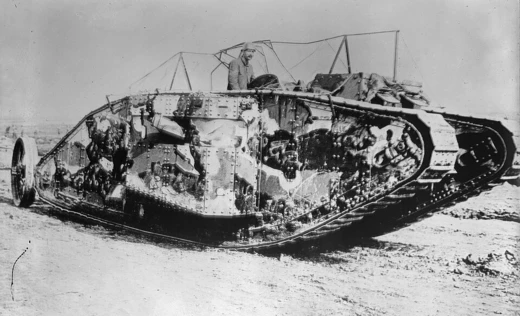
Tiger II
German heavy tank of WWII, successor to the Tiger I.

via Wikipedia: Tiger II · see source
The Tiger II was a German heavy tank of the Second World War, officially designated Panzerkampfwagen Tiger Ausf. B and known informally as the Königstiger or King Tiger. It combined thick armor with sloped armor inspired by the Panther medium tank, making it one of the most formidable and costly tanks produced by Germany at the time.
- Official designation
- Panzerkampfwagen Tiger Ausf. B
- Weight
- Almost 70 tonnes (77 tons)
- Armament
- 8.8 cm KwK 43 L/71 anti-tank cannon
Verified Timeline
Lore & Background
Development of the Tiger II began in 1937 with a design contract awarded to Henschel, followed by another contract to Porsche in 1939. Both prototypes used the same Krupp turret design, but differed in hull, transmission, suspension, and automotive features. The Henschel version featured a conventional hull with sloped armor and overlapping road wheels, while the Porsche designs included a rear-mounted turret and a mid-mounted engine, with some using a gasoline-electric drive. Henschel ultimately won the production contract, and all Tiger IIs were built by the firm. Two turret designs were used: an initial design often called the "Porsche" turret (though it was a Krupp design) with a rounded front and a bulge for the commander's cupola, and a later "production" turret with a thicker flat face and simplified sides. The tank was armed with the 8.8 cm KwK 43 L/71 gun, which was highly accurate in practice, with first-round hit probabilities exceeding 80% at 1,000 meters in combat. The turret traverse was powered by a hydraulic motor, allowing precise control. On the Eastern Front, the 501st Heavy Panzer Battalion was the first unit equipped with the tank. The chassis also served as the basis for the Jagdtiger turretless anti-tank vehicle.
Reader's Guide
The Tiger II represents the apex of German heavy tank design in World War II, combining thick, sloped armor with a powerful long-barreled 8.8 cm gun that could defeat most Allied armor at long ranges. The tank's weight of nearly 70 tonnes made it slow and difficult to transport, requiring special narrow tracks for rail movement. The Tiger II's legacy is that of a formidable but rare battlefield asset, whose design influenced later armored vehicle concepts. Its reputation as a "King Tiger" endures in popular culture, though its operational impact was constrained by low numbers and logistical challenges. The tank's development history, including the rivalry between Henschel and Porsche designs, highlights the technological ambitions and resource constraints of German wartime industry.
Did You Know?
- The Tiger II was also known informally as the Königstiger, meaning 'Bengal tiger' or 'King Tiger'.
- The initial turret design is often misleadingly called the 'Porsche' turret, but it was actually the initial Krupp design for both prototypes.
- The tank's gun had a 100% probability of a first-round hit on a 2 m high, 2.5 m wide target at 1,000 m during practice.
- The command variant, Panzerbefehlswagen Tiger Ausf. B, had reduced ammunition capacity to accommodate extra radios.
The Henschel-Porsche Design Rivalry
The Tiger II's development traces back to 1937, when Henschel was awarded a design contract, with Porsche receiving a competing contract in 1939. Both firms built their prototypes around the same Krupp turret, yet their hull, transmission, suspension, and powertrain philosophies diverged dramatically. Henschel chose a conventional sloped-armour hull echoing the Panther, a rear-mounted engine, and nine overlapping steel-tired road wheels per side on transverse torsion bars. Crucially, the wheels overlapped without interleaving, simplifying maintenance compared to the full Schachtellaufwerk system used on most German half-tracks and later inherited by the Tiger I and Panther. Porsche pursued a far more radical route: a mid-mounted engine, a rear-positioned turret, a suspension derived from the Elefant tank destroyer with six paired bogies on short longitudinal torsion bars, and in one variant a gasoline-electric drive with two parallel drivetrains, one per side, each pairing a gasoline engine, generator, motor, and sprocket. This hybrid-like system had appeared in the rejected Tiger (P), the French Saint-Chamond, and the Char 2C. A hydraulic drive was also floated. Porsche's unorthodox ideas won little favour, and Henschel secured the production contract, with every Tiger II built by that firm.
Armament and Firepower
The Tiger II's primary weapon was the long-barrelled 8.8 cm KwK 43 L/71 anti-tank cannon, a 71-calibre gun that, paired with the Leitz Turmzielfernrohr 9d monocular sight, delivered exceptional accuracy. For soft targets, the Sprenggranate 43 high-explosive round was available, and the Hohlgranate 39 offered 90 mm penetration at any range as a dual-purpose option. Turret traverse was driven by a Boehringer-Sturm L4S hydraulic motor linked to the main engine, giving the gunner high and low speed settings via a right-hand lever and foot pedals, with minimum traverse as slow as 0.1 degrees per second for precise aiming.
Production Constraints and Combat Debut
It combined the Tiger I's thick armour with the sloped-armour philosophy of the Panther medium tank. The tank was issued to heavy tank battalions of both the Army and the Waffen-SS. On the Eastern Front, the 501st Heavy Panzer Battalion was the first unit to be outfitted with the Tiger II. The chassis also served as the foundation for the Jagdtiger, a turretless Jagdpanzer anti-tank vehicle. The tank carried the official designation Panzerkampfwagen Tiger Ausf. B, with the ordnance inventory number Sd.Kfz. Allied soldiers commonly referred to it as the King Tiger or Royal Tiger, while German troops used the informal name Königstiger, literally meaning Bengal tiger or King Tiger.
Turret Design Evolution
Two turret designs appeared on production Tiger IIs, and their naming has caused persistent confusion. The initial turret, often mislabelled the Porsche turret on the mistaken assumption that Porsche designed it for their prototype, was in fact the original Krupp design intended for both competing prototypes. It featured a rounded front, steeply sloped sides, and a difficult-to-manufacture curved bulge on the turret's left side to house the commander's cupola. Only fifty of these early turrets were mated to Henschel hulls and saw action. In December 1943, the more common production turret, sometimes erroneously called the Henschel turret, entered service. This revised design simplified the profile with a significantly thicker flat face, which eliminated the shot-trap problem caused by the curved front of the earlier model. The sides were less steeply sloped, removing the need for the cupola bulge entirely and freeing up additional internal space for ammunition storage. Both turret variants were engineered to mount the 8.8 cm KwK 43 L/71 gun, and the shift to the flatter-faced production turret represented a practical engineering compromise between manufacturability, protection, and crew ergonomics.
Common Misconceptions (Editorial)
- A common misconception is that the initial turret design on the Tiger II was a Porsche design. However, the facts confirm that both prototype turrets were actually Krupp designs, and the early rounded turret is misleadingly called the "Porsche" turret. - Some believe the tank's combat accuracy was unreliable, but the record states its 8.8 cm KwK 43 L/71 gun had a 100% first-round hit probability during practice on a standard-sized target at 1,000 meters, and over 80% hit probability at the same range in actual combat.
Why It Matters (Editorial)
The Tiger II endures as a symbol of late-war German engineering ambition and overreach—a machine where formidable firepower and sloped armor came at the cost of immense weight and complexity. Its legacy reflects the broader paradox of Nazi armor: technically impressive, yet too resource-intensive and unreliable to change the war's outcome, making it a lasting subject of study for military historians and enthusiasts alike.
Gallery
Frequently Asked Questions
What is the Tiger II tank?
The Tiger II was a German heavy tank fielded during World War II, serving as the direct successor to the Tiger I. Its official name was Panzerkampfwagen Tiger Ausf. B, though crews and allies more commonly called it the Königstiger, or King Tiger.
What main gun did the Tiger II use?
It was armed with the 8.8 cm KwK 43 L/71 anti-tank cannon, a long-barreled, high-velocity gun that could defeat most Allied armor at combat range.
More in Tanks 1-21
Spotted an error? Know more?
This is a living reference — every entry is fact-audited, and reader corrections feed straight into our audit queue. Suggest an edit · See this site's audit record