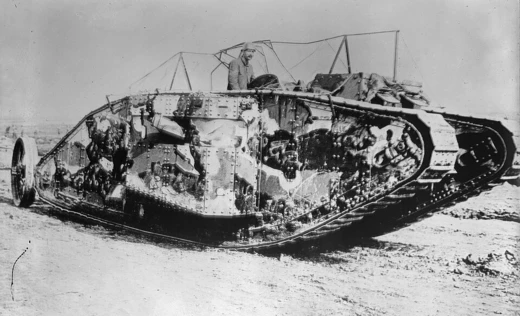
Churchill tank
Heavy British infantry tank of the Second World War.

The Tank, Infantry, Mk IV (A22) Churchill was a British infantry tank used in the Second World War. It was best known for its heavy armour, large longitudinal chassis with all-around tracks, ability to climb steep slopes, and use as the basis for many specialist vehicles. It was one of the heaviest Allied tanks of the war.
- type
- Infantry tank
- country
- United Kingdom
- in_service
- 1941–1945
- weight
- Heavy (one of the heaviest Allied tanks)
- armament
- QF 2 pounder gun (early marks); later QF 6 pounder or British 75 mm gun
- notable_variants
- Mark III, Mark IV, Mark VII (A22F)
Lore & Background
The Churchill's design originated from the expectation that war in Europe might resemble First World War conditions, emphasizing the ability to cross difficult ground. It was hurried into production to build up British defences against a possible German invasion. The first vehicles had flaws that had to be overcome before wide acceptance. After several marks, the better-armoured Mark VII entered service and performed well in later stages of the war. The tank was named after John Churchill, 1st Duke of Marlborough; Winston Churchill remarked that it was named after him when they found it was 'no damn good.'
Reader's Guide
The Churchill tank was used by British and other Commonwealth forces in the North African, Italian, and North-West Europe campaigns. Despite early mechanical faults and inadequate armament, the Churchill proved versatile and was adapted for many specialist roles. Its heavy armour and ability to climb steep slopes made it valuable in later offensives, such as the Battle of Normandy. The Churchill's legacy lies in its role as a heavily protected infantry support tank and as a platform for numerous specialized variants, including engineering and flame-throwing vehicles.
Did You Know?
- The Churchill was named after John Churchill, 1st Duke of Marlborough, not after Prime Minister Winston Churchill.
- The first Churchill tanks were produced in June 1941, exactly one year after the design specification was given to Vauxhall.
- The Churchill was one of the heaviest Allied tanks of the Second World War.
Common Misconceptions (Editorial)
Some people assume the Churchill tank was named after Prime Minister Winston Churchill, but it was actually named after John Churchill, 1st Duke of Marlborough. Another common misconception is that the Churchill was a successful design from the start; in reality, the first vehicles had significant flaws that had to be overcome before they gained wide acceptance.
Why It Matters (Editorial)
The Churchill tank endures as a symbol of British wartime ingenuity and adaptability, serving not only as a resilient frontline infantry tank but also as the platform for numerous specialized vehicles like bridge-layers and flame-throwers. Its ability to climb steep slopes and cross difficult terrain, born from lessons of the First World War, made it a uniquely capable vehicle in the later stages of the conflict, proving that sometimes the most effective designs come from learning from past hardships.
Frequently Asked Questions
What is the Churchill tank?
The Churchill tank, formally designated Tank, Infantry, Mk IV (A22), was a heavy British infantry tank that saw service from 1941 to 1945 during the Second World War. It ranked among the heaviest Allied tanks of the conflict.
What made the Churchill tank stand out from other tanks of its era?
Its defining traits were exceptionally thick armour, a long chassis with tracks running the full length of the hull, and a remarkable ability to climb very steep slopes. These qualities made it a natural platform for crossing obstacles and operating in rough terrain.
What gun did the Churchill tank carry?
Early marks were armed with a QF 2-pounder anti-tank gun, while later production vehicles received a QF 6-pounder or a British 75 mm gun for greater stopping power.
Why is the Churchill tank considered important in tank history?
Beyond its frontline combat role, the Churchill's sturdy chassis was adapted into a wide family of specialist vehicles, from flame-throwers to assault bridges. Its emphasis on maximum protection and cross-country capability left a lasting mark on British tank design philosophy.
More in Tanks 1-21
Spotted an error? Know more?
This is a living reference — every entry is fact-audited, and reader corrections feed straight into our audit queue. Suggest an edit · See this site's audit record