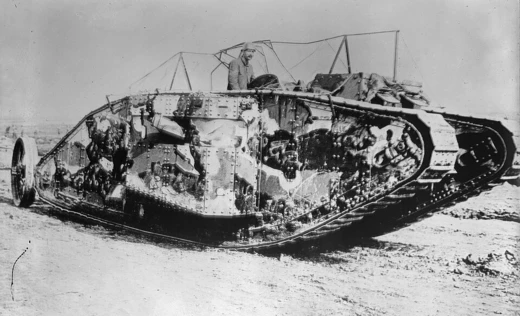
Mark I
Most numerous British tank of the First World War, first used at Messines Ridge.

via Wikipedia: Mark IV tank · see source
The Mark IV (pronounced Mark four) was a British tank of the First World War, introduced in 1917. It benefited from significant developments of the Mark I tank, with main improvements in armour, the re-siting of the fuel tank and ease of transport. A total of 1,220 Mark IVs were built, making it the most numerous British tank of the war. It was first used in mid 1917 at the Battle of Messines Ridge and remained in British service until the end of the war.
- field
- Armoured fighting vehicle
- nationality
- British
- manufacturer
- Metropolitan, Fosters of Lincoln, Armstrong-Whitworth, Coventry Ordnance Works,
- crew
- 8
Lore & Background
The director of the Tank Supply Department, Albert Gerald Stern, first intended to fit the Mark IV with a new engine and transmission. Production of battle tanks was halted until the new design was ready, necessitating the use of the Mark II and III as interim training tanks. Failing to complete development soon enough to start production in time to have 200 tanks ready for the promised date of 1 April 1917, Stern was ultimately forced to take a Mark IV into production in May 1917 that was only slightly different from the Mark I tank. The Mark IV Male initially carried three Lewis machine guns and a QF 6 pdr 6 cwt gun in each sponson, with its barrel shortened as it had been found that the longer original was apt to strike obstacles or dig into the ground. The Female had five Lewis guns but no 6-pounders. At the 1917 Battle of Cambrai, Mark IV tanks were equipped with fascines, bundles of brushwood bound with chains, about 10 ft long and 4 ft 6 in in diameter carried on the roof of the cab. They were dropped into trenches to allow the tank to cross over more easily.
Reader's Guide
The Mark IV was first used in large numbers on 7 June 1917, during the British assault on Messines Ridge. Crossing dry but heavily cratered terrain, many of the 60-plus Mark IVs lagged behind the infantry, but several made important contributions to the battle. By comparison, at the Third Battle of Ypres from 31 July, where the preliminary 24-day long barrage had destroyed all drainage and heavy rain had soaked the field, the tanks found it heavy going and contributed little. Nearly 460 Mark IV tanks were used during the Battle of Cambrai in November 1917, showing that a large concentration of tanks could quickly overcome even the most sophisticated trench systems. In the aftermath of the German spring offensive on the Western Front, the first tank-to-tank battle was between Mk IV tanks and German A7Vs in the Second Battle of Villers-Bretonneux in April 1918. About 40 captured Mark IVs were employed by the Germans as Beutepanzerwagen with a crew of 12, forming four tank companies from December 1917.
Did You Know?
- A total of 1,220 Mark IVs were built: 420 'Males', 595 'Females' and 205 Tank Tenders.
- The Mark IV was the first tank fitted with 'unditching beams' by field workshops.
- The last Mark IV to see service, briefly, was Excellent, a Mark IV male restored to operational status in 1940.
- About 40 captured Mark IVs were employed by the Germans as Beutepanzerwagen with a crew of 12.
- At the Battle of Cambrai, Mark IV tanks were equipped with fascines about 10 ft long and 4 ft 6 in in diameter.
Common Misconceptions (Editorial)
One common misconception is that the Mark IV was a completely new design built from scratch; in fact, due to delays in developing a new engine and transmission, it was forced into production in May 1917 as only slightly different from the Mark I. Another is that the Mark IV was the first British tank of the war, but it was introduced in 1917 after the Mark I and the interim Mark II and III training tanks. A third error is that its main armament was the same as earlier models—in reality, the 6-pounder gun on the Male was given a shortened barrel because the longer original tended to strike obstacles or dig into the ground.
Why It Matters (Editorial)
The Mark IV matters not just as a mechanical artifact but as a battlefield pioneer that helped define armored warfare. Its use of fascines at Cambrai and unditching beams showed how quickly tank crews improvised to overcome trench obstacles, a legacy of adaptability that still resonates in modern armored tactics. This tank’s sheer numbers—the most of any British tank in the war—cemented its role in breaking the stalemate of the trenches.
Frequently Asked Questions
What is the Mark I?
The Mark I is a British armoured fighting vehicle from the First World War, recognized as the very first tank ever deployed in actual combat. It was a tracked, armoured, and armed machine built specifically to overcome the problems of trench warfare.
What was the Mark I designed to do?
Its primary mission was to shatter the deadlock of the Western Front by ploughing through barbed wire, climbing over trenches, and crossing otherwise impassable terrain. It gave infantry a mobile platform capable of breaching enemy positions that static defences had locked down.
When and where did the Mark I first fight?
It saw its first combat action on 15 September 1916 at the Battle of Flers-Courcelette on the Somme. That engagement marked the very first time any tank had been used in a real battle.
Who built the Mark I and how many crew did it need?
The vehicle was manufactured by two British firms: William Foster & Co. and the Metropolitan Carriage, Wagon, and Finance Company. A typical crew consisted of eight men, including two drivers, two gearsmen, and four additional personnel.
Why does the Mark I matter in tank history?
It set the template for every armoured fighting vehicle that followed, proving that a tracked, armoured machine could finally break the stalemate that had defined the Western Front since 1914. Without the Mark I, the entire concept of the modern tank would have had no starting point.
More in Tanks 1-21
Spotted an error? Know more?
This is a living reference — every entry is fact-audited, and reader corrections feed straight into our audit queue. Suggest an edit · See this site's audit record