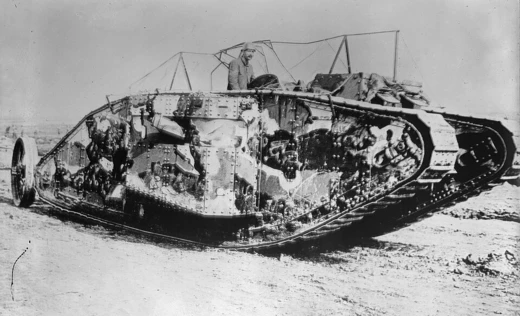
Matilda II
Heavily armoured British infantry tank of World War II.

via Wikipedia: Matilda II · see source
The Infantry Tank Mark II, better known as the Matilda II or Matilda Senior, was a British infantry tank of the Second World War. It was designed as a gun-armed counterpart to the machine gun-armed, two-man A11 Infantry Tank Mark I, and its heavy armour made it an excellent infantry support tank, though it had limited speed and armament. It was the only British tank to serve from the start of the war to its end, and it is particularly associated with the North African campaign.
- field
- Armoured warfare
- nationality
- British
- known_for
- Heavy armour, service throughout World War II, North African campaign
- weight
- Approximately 27 long tons (27 t; 30 short tons)
- armament
- Ordnance QF 2-pounder (40 mm) tank gun and machine gun
- armour
- Up to 78 mm (3.1 in) front glacis; 75 mm (2.95 in) turret all round
- speed
- About 6 mph (9.7 km/h) on desert terrain; 16 mph (26 km/h) on roads
Verified Timeline
Lore & Background
The design began as the A12 specification in 1936, as a gun-armed counterpart to the machine gun-armed, two-man A11 Infantry Tank Mark I. The A12 was produced by the Royal Arsenal, Woolwich, and manufactured by Vulcan Foundry. It used two AEC straight-six water-cooled diesel engines, linked along a common shaft, and its suspension was based on the 'Japanese Type' bell crank suspension used on the A7 medium tank. The first order for 140 tanks was placed in June 1938, and only two were available for service by the outbreak of World War II in 1939. The Matilda II weighed around 27 long tons and had a three-man turret armed with an Ordnance QF 2-pounder gun. Its heavy armour—up to 78 mm on the front glacis and 75 mm on the turret—was the heaviest of its era, surpassing contemporary German Panzer III and Panzer IV tanks which had 30 to 50 mm hull armour. However, it lacked a high-explosive round for its main gun, limiting its effectiveness against unarmoured targets. The tank's slow speed, about 6 mph on desert terrain, was due to its heavy armour and a troublesome suspension system. It was replaced in front-line service by the cheaper and lighter Infantry Tank Mk III Valentine from late 1941.
Reader's Guide
The Matilda II holds a significant place in British armoured warfare history as the only British tank to serve from the start of World War II to its end. Its heavy armour made it a formidable opponent in the North African campaign, where for a time in 1940–1941 it earned the nickname 'Queen of the Desert' for its protection against contemporary anti-tank weapons. However, its slow speed—about 6 mph on desert terrain and 16 mph on roads—and lack of a high-explosive round limited its tactical flexibility, and it was eventually superseded by the Valentine tank from late 1941. The Matilda II's design reflected the British doctrine of infantry tanks, which prioritized armour and trench-crossing ability over speed. Its legacy lies in its role as a durable and well-protected vehicle that supported infantry in key battles, though its mechanical complexity and maintenance challenges were notable drawbacks. The tank's armour remained impressive even by later war standards, with side and rear armour relatively heavy even at the end of the war when tanks like the M4 Sherman carried about 40 mm.
Did You Know?
- The Matilda II was the only British tank to serve from the start of World War II to its end.
- Only two Matilda IIs were available for service by the outbreak of World War II in 1939.
- The tank used two AEC straight-six water-cooled diesel engines from London buses, each providing up to 87 hp.
- The Matilda II's front glacis armour was up to 78 mm thick, heavier than contemporary German Panzer III and IV tanks which had 30 to 50 mm.
- The turret was equipped with a power traverse system and a manually operated mechanical emergency assist.
Common Misconceptions (Editorial)
- Some believe the Matilda II was the same as the Matilda I (A11), but the Matilda II was a separate, gun-armed design (A12) with a three-man turret, whereas the Matilda I was a two-man, machine gun-armed tank. - It is often assumed that the tank’s slowness was purely due to its heavy armour, but its troublesome suspension system also contributed to the 6 mph speed on desert terrain. - People may think the Matilda II’s 2-pounder gun was effective against all targets; in fact, it lacked a high-explosive round, limiting its effectiveness against unarmoured targets.
Why It Matters (Editorial)
The Matilda II endures as a symbol of British industrial resilience, being the only British tank to serve from the start to the end of the Second World War. Its extraordinary frontal armour, which surpassed contemporary German tanks, made it a formidable opponent in the North African campaign, even if its slow speed and inadequate gun ultimately limited its battlefield longevity.
Frequently Asked Questions
What is the Matilda II?
The Matilda II, often called the Matilda Senior, was a British infantry tank produced during World War II. It was conceived as the gun-armed follow-up to the earlier A11 Mark I, which was limited to a single machine gun.
What made the Matilda II stand out on the battlefield?
Its defining strength was remarkably thick protection: the front glacis plate measured 78 mm and the turret 75 mm all around. That level of armour rendered it nearly immune to most early-war anti-tank fire, though it also meant the vehicle could barely exceed a crawl speed.
What weapon did the Matilda II carry?
The turret housed an Ordnance QF 2-pounder 40 mm tank gun alongside a coaxial machine gun. The 2-pounder was lethal against the lighter armoured vehicles of the early war, but it grew inadequate as German tank armour thickened.
How long did the Matilda II remain in active service?
It is the only British tank to have been in operational use from the outbreak of World War II right through to the war's end. Its most celebrated period was the North African campaign, where its heavy plating gave it a decisive edge over lighter Axis opponents.
Why do tank historians consider the Matilda II significant?
It proved that a slow, heavily armoured vehicle could remain a practical infantry-support tool across an entire conflict. Its unbroken service record and standout performance in the desert wars made it a defining symbol of British armoured warfare in the 1940s.
More in Tanks 1-21
Spotted an error? Know more?
This is a living reference — every entry is fact-audited, and reader corrections feed straight into our audit queue. Suggest an edit · See this site's audit record