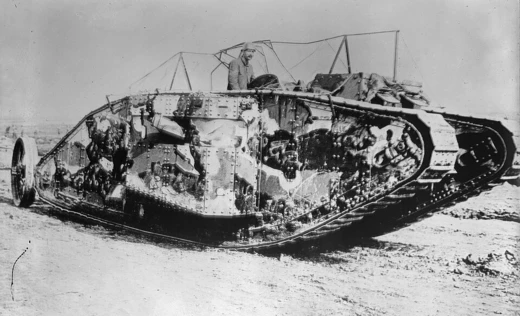
Renault FT
First production tank with a fully rotating turret.

via Wikipedia: Renault FT · see source
The Renault FT is a French light tank designed and produced by the Société des Automobiles Renault. It is considered among the most revolutionary and influential tank designs in history, being the first production tank to have its armament within a fully rotating turret. Its configuration—crew compartment at the front, engine at the back, and main armament in a revolving turret—became and remains the standard tank layout, leading some armoured warfare historians to call it the world's first modern tank.
- field
- Armoured warfare / Tank design
- nationality
- French
- manufacturer
- Société des Automobiles Renault
- designer
- Louis Renault (overall design), Rodolphe Ernst-Metzmaier (execution plans)
- production_start
- 1917
- total_produced
- Over 3,000 by France (most in 1918); 2,697 delivered before Armistice
- known_for
- First production tank with a fully rotating turret; established the standard tan
Verified Timeline
Lore & Background
The Renault FT was designed and produced by the Société des Automobiles Renault. It is thought possible that Louis Renault began working on the idea as early as 21 December 1915, after a visit from Colonel J. B. E. Estienne, who had drawn up plans for a tracked armoured vehicle based on the Holt caterpillar tractor. Renault initially declined, saying his company was operating at full capacity producing war materiel and that he had no experience of tracked vehicles. After a chance meeting on 16 July 1916, Estienne asked him to reconsider, which he did, favourably. Louis Renault himself conceived the new tank's overall design and set its basic specifications, imposing a 7-ton limit. Industrial designer Rodolphe Ernst-Metzmaier generated the execution plans, and Charles-Edmond Serre organized and supervised mass production. The FT's tracks were kept automatically under tension to prevent derailments, while a rounded tailpiece facilitated the crossing of trenches. Because the engine had been designed to function normally under any slant, very steep slopes could be negotiated without loss of power. Effective internal ventilation was provided by the engine's radiator fan, which drew its air through the front crew compartment and forced it out through the rear engine compartment. The prototype was refined during the second half of 1917, but the FT remained plagued by radiator fan belt problems throughout the war. Only 84 were produced in 1917, but 2,697 were delivered to the French army before the Armistice.
Reader's Guide
The Renault FT's significance lies in its revolutionary layout, which became the standard for all subsequent tanks: crew compartment at the front, engine at the back, and main armament in a fully rotating turret. Over 3,000 were manufactured by France, most in 1918, and after World War I it was exported in large numbers. Copies and derivatives were produced in the United States (M1917 light tank), Italy (Fiat 3000), and the Soviet Union (T-18 tank). The FT saw combat during interwar conflicts but was considered obsolete at the outbreak of World War II. Its naming has caused confusion: the letters 'FT' came from Renault's internal production code, not from any French phrase, and the designations 'FT-17' or 'FT 17' arose after the war in history books. The American version was designated M1917. The FT's production involved multiple French manufacturers—Renault accounted for 1,850 of the original order for 3,530, Berliet 800, SOMUA 600, and Delaunay-Belleville 280—with Louis Renault agreeing to waive royalties for all French manufacturers. The first turret was a circular cast steel version designed for a Hotchkiss 8mm machine gun; in April 1917 Estienne decided some vehicles should carry a 37mm Puteaux gun. The Berliet Company produced a polygonal turret of riveted plate called 'omnibus', which could mount either weapon. In 1918 Forges et aciéries Paul Girod produced a successful circular turret that was mostly cast with some rolled parts, also an 'omnibus' design.
Did You Know?
- The letters 'FT' came from Renault's internal two-letter production code, not from any French phrase like 'faible tonnage' or 'franchisseur de tranchées'.
- Louis Renault initially declined Colonel Estienne's proposal on 21 December 1915, citing full capacity and no experience with tracked vehicles, but reconsidered after a chance meeting on 16 July 1916.
- Only 84 Renault FTs were produced in 1917, but 2,697 were delivered to the French army before the Armistice.
- The American version, produced under licence, was designated the M1917, and no M1917s reached the American Expeditionary Forces before the war ended.
- The FT's official designation was not changed until the 1930s, when it was fitted with a 1931 Reibel machine gun and renamed the FT modifié 31.
Common Misconceptions (Editorial)
1. Many assume "FT" stands for a French phrase like "faible tonnage" or "franchisseur de tranchées," but it was actually Renault's internal two-letter production code.
2. Some believe the Renault FT was a major battlefield success from the start, but only 84 were produced in 1917, and it suffered from persistent radiator fan belt problems throughout the war.
3. It is often thought that the American M1917 (the licence-built U.S. version) saw combat in World War I, but no M1917s reached the American Expeditionary Forces before the Armistice.
Why It Matters (Editorial)
The Renault FT matters because it established the fundamental layout—front crew, rear engine, rotating turret—that virtually every main battle tank follows today. Its design proved that a light, agile, and crew-friendly vehicle could transform trench warfare, and its enduring influence is a reminder that revolutionary ideas often come from solving immediate, practical problems under extreme constraints.
Frequently Asked Questions
What is the Renault FT?
The Renault FT is a French light tank built by the Société des Automobiles Renault, first entering production in 1917. It is widely regarded as the most influential tank design ever created, establishing the basic layout still used in modern armoured vehicles.
Why is the Renault FT called the first modern tank?
It was the first production tank to house its main gun inside a fully revolving turret rather than a fixed or semi-rotating mount. That front-crew, rear-engine, center-turret arrangement became the blueprint for virtually every tank that followed, leading armoured warfare historians to credit it as the origin of the modern tank concept.
Who designed the Renault FT?
The overall design is attributed to Louis Renault, while the detailed execution plans were carried out by Rodolphe Ernst-Metzmaier. The vehicle was produced under the Société des Automobiles Renault banner for the French military.
How many Renault FT tanks were built?
France produced over 3,000 units, with the majority rolling off the line in 1918. Of those, 2,697 had been delivered to the French Army before the Armistice ended World War I.
What made the Renault FT's turret so revolutionary?
Prior to the FT, tank guns were either fixed to the hull or could only traverse in a limited arc, forcing the entire vehicle to turn to aim. The FT's fully 360-degree rotating turret let the crew engage targets in any direction without repositioning the whole tank, a capability that remained the standard for the next century of tank warfare.
More in Tanks 1-21
Spotted an error? Know more?
This is a living reference — every entry is fact-audited, and reader corrections feed straight into our audit queue. Suggest an edit · See this site's audit record